Advanced road awareness

You already control the car. We change what you see before a situation develops.

Vezha Advanced Driving Institute runs a three-part course for drivers with two or more years behind the wheel and roughly 30,000 km: theoretical instruction, simulator scenarios, and a written debrief dossier prepared by the instructor after your final run.

Next group in Kyiv starts 14 March. Course fee 12,400 UAH, itemised on the courses page.

02 / Measured evidence

Numbers taken from the register and the debrief room, not from a brochure.

Cohort
1,840 Drivers who completed the advanced road awareness course since 2019. Source: Vezha enrolment register, updated each quarter.
Following distance
27% Average drop in following-distance variance at checkpoint three, measured across 412 paired runs with the same two instructors.
Course fee
18,400 UAH Publicly listed and itemised. Fuel is billed at cost; vehicle hire and state examination fees are not included.

Full line-item breakdown on the courses page.

02 / Advanced road awareness

Hazard anticipation theory, taught before the road

Vezha is built for drivers who already control the car. These three modules change what you notice before a situation develops, and each one is rehearsed in the simulation lab before it is tested in traffic.

  1. Module 01

    Scan coverage and the two-second horizon

    A theory session on where your eyes should rest at 30, 60 and 100 metres ahead, and why a steady mirror sweep keeps your picture of the road current. Candidates who arrive with ten years of experience are usually surprised by how much of that picture they were leaving out.

    Checklist

    • Mirror sweep every 5 to 8 seconds
    • Fixation time held under 1.2 seconds
    • Blind-spot confirmation before every lane change
  2. Module 02

    Following distance under changing load

    You already stop cleanly at a steady speed. This module measures what happens to the gap when traffic, rain and distraction arrive together, and hands you one fixed rule for restoring it without braking late or braking hard.

    Checklist

    • Baseline two seconds, raised to four in rain
    • Gap restored within three seconds of a cut-in
    • Brake-tap warning instead of abrupt braking
  3. Module 03

    Reading intent before the manoeuvre

    Wheel angle, head position, front-wheel creep at a junction. Instructors watch for these cues long before an indicator appears, and the module turns that habit into a routine you can run at every intersection without thinking about it.

    Checklist

    • Front-wheel angle check at every junction
    • Door-zone scan past parked rows on 60 km/h streets
    • Each hazard called aloud during the run

All three modules form one course of 12 hours. See the full course breakdown, or check the next cohort date.

03 / Simulation lab

Three rigs, twelve scenario passes, one dossier

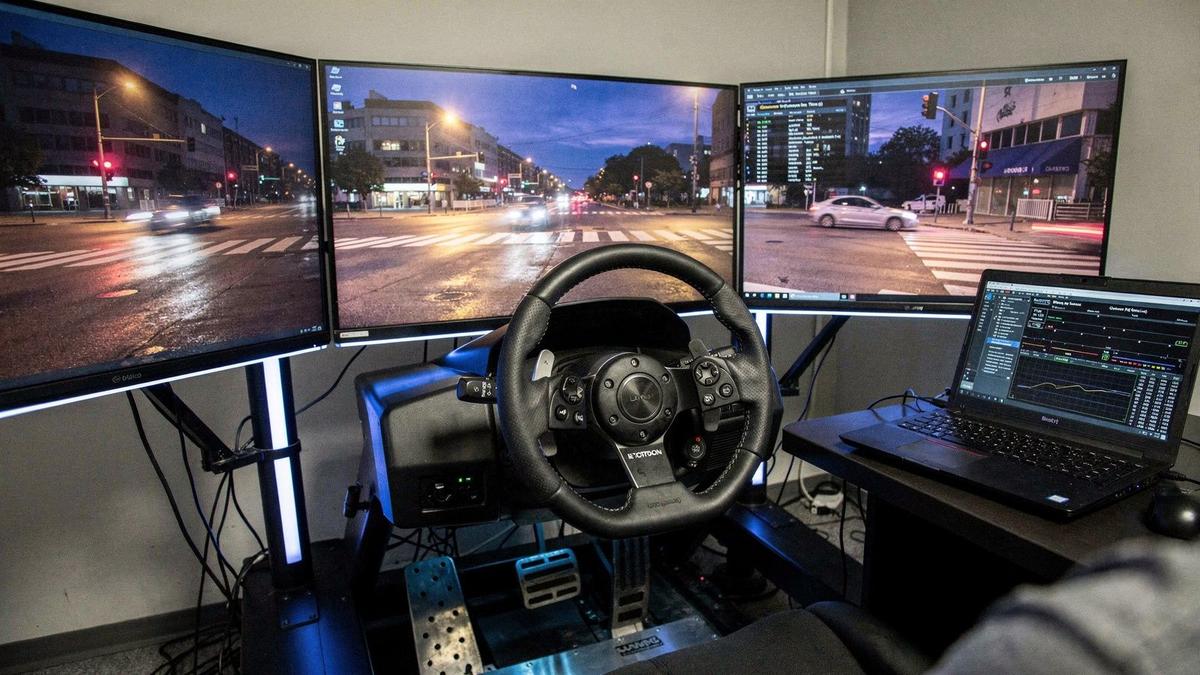
The lab runs fixed-base rigs with triple screens, a force-feedback wheel and an instructor console that logs every glance. Scenarios repeat until the picture stops surprising you: a wet junction with a blocked sightline, a dusk merge with one closing gap, and a parked-car row where a pedestrian steps off the kerb.

Windscreen scan coverage
42%
Reaction timing, wet junction
1.4 s
Following distance, checkpoint 3
1.8 s

Eyes stay on the car ahead. Mirrors are read after the brake, never before it.

  • Wet junction, blocked sightline, 40 km/h approach
  • Dusk merge, three lanes, one closing gap
  • Parked-car row, pedestrian at the kerb

Reserve a lab slot

Interior of a driving simulator rig with triple screens, force-feedback wheel and instructor console 1 2 3
  1. Instructor console, live glance timing
  2. Wheel and pedal telemetry feed
  3. Left screen, junction mouth and kerb line

05 / Instructor debrief

Someone writes down what you did not see.

The debrief dossier is the proof device of the course. It is not a certificate of attendance. It is a written record of how your eyes and hands behaved on the route you just drove, produced by the instructor who sat beside you.

“Vezha is for drivers who already control the car. The course changes what they see before a situation develops.”

Oleh Kovalenko, lead instructor

Every instructor holds a category B licence held for 12 years or more, a defensive driving instructor certification, and at least 400 hours of supervised advanced road awareness instruction. Each dossier is reviewed by a second instructor before it is signed and released, normally within 24 hours of the session.

Three components produce the file: theoretical instruction, practical simulations in the lab, and the on-road drive where the checkpoints are recorded. Nothing in the dossier is estimated. Each line comes from a timestamp.

See how the three components fit together

06 / Enrollment

Reserve a seat in the next advanced awareness cohort

Vezha is built for drivers who already control the car. The course changes what you see before a situation develops, so every reservation starts with a short intake call rather than an online checkout.

  • Two evenings of theoretical instruction covering scan patterns and hazard anticipation.
  • Three practical simulation sessions with logged reaction timing at fixed checkpoints.
  • A written debrief dossier, including following distance records, within five working days.

05 / Contact

Reserve a seat, or ask what the debrief dossier measures

Cohorts run with six drivers, so every participant gets a personal debrief on scan coverage, reaction timing and following distance. Tell us your mileage band and the roads you drive most, and we will confirm which course fits your experience.

Direct lines

Office
Office 301, Business Center 'Panorama', 45 Khreshchatyk St, Kyiv, 01001, Ukraine
Hours
Monday to Saturday, 09:00 to 19:00